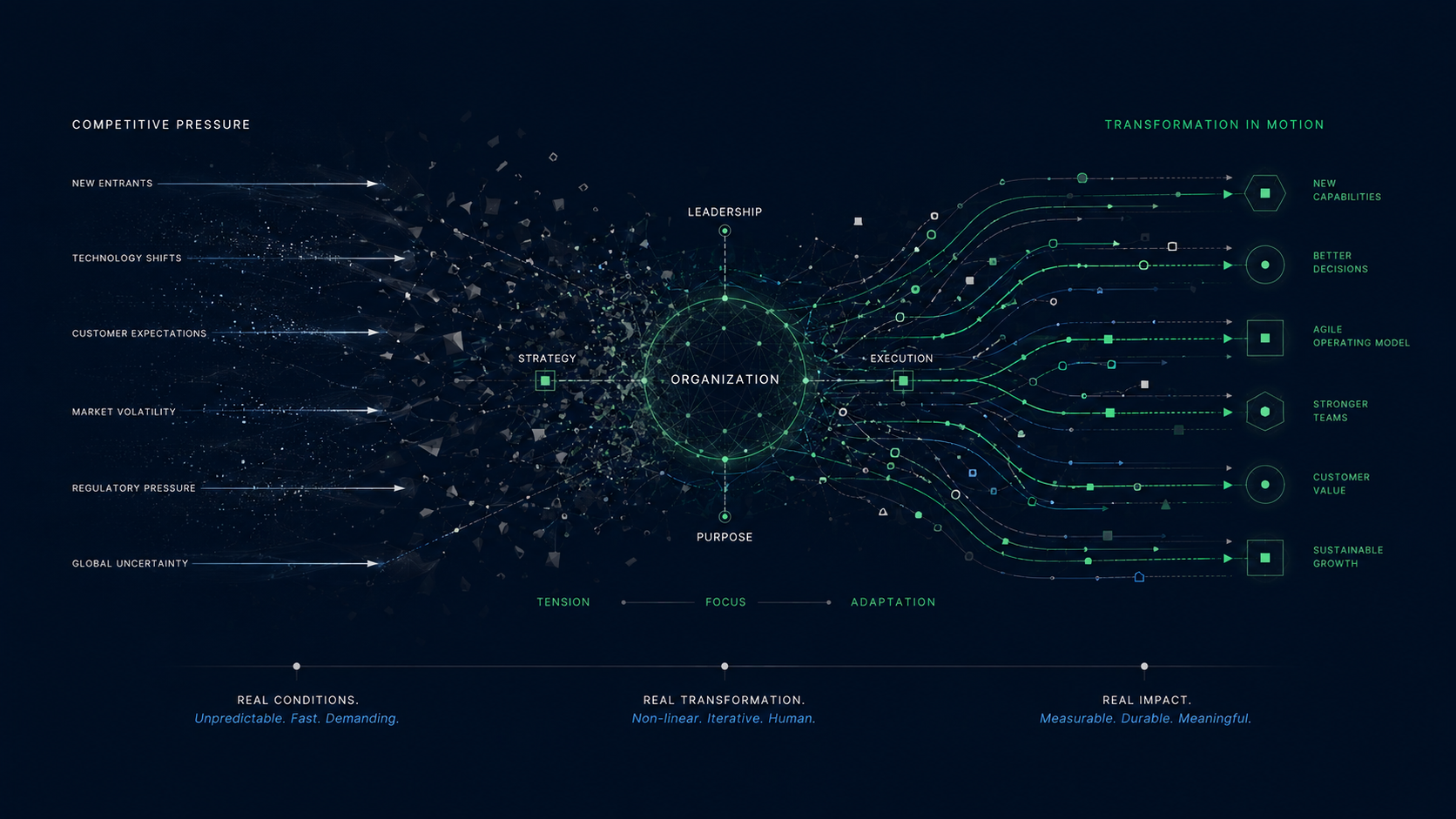
One of the biggest disconnects in transformation discourse is the assumption that companies transform under stable conditions.
Most do not.
In reality, transformation usually happens while organizations are simultaneously trying to:
- protect revenue
- reduce costs
- modernize systems
- improve customer experience
- respond to competitors
- ship products
- stabilize operations
- and satisfy shareholder expectations
Transformation is rarely the only priority.
And that changes everything.
A lot of transformation literature presents change as if organizations could temporarily pause operational pressure while redesigning themselves calmly and strategically.
But most companies do not have that luxury.
According to PwC, more than 50% of CEOs globally believe their current business models may not remain economically viable within the next decade without significant reinvention.
That creates urgency.
And urgency changes organizational behavior dramatically.
When survival pressure increases, organizations naturally become:
more reactive,
more political,
more risk-sensitive,
and more execution-focused.
This is one reason transformation initiatives often create internal tension.
Because from the perspective of operational teams, transformation can sometimes feel less like "the way forward" and more like "something additional" layered on top of already overwhelming expectations.
Teams are asked to:
- maintain operations
- deliver revenue
- hit targets
- serve customers
- and simultaneously redesign workflows, systems, and behaviors
The cognitive load becomes enormous.
This is where many transformation strategies fail conceptually.
They treat transformation as a parallel initiative rather than integrating it into the operational reality of the business.
But businesses do not transform separately from execution.
They transform through execution.
That distinction matters.
In healthy transformation environments, modernization supports operational goals:
- faster delivery
- better customer experience
- better data
- better decision-making
- better scalability
In unhealthy environments, transformation becomes disconnected from operational pressure.
It starts feeling ceremonial:
new frameworks,
new terminology,
new governance,
new workshops,
while the business continues struggling underneath.
And eventually teams stop seeing transformation as progress.
They begin seeing it as friction.
One of the realities I have observed repeatedly is that organizations rarely resist transformation because they dislike improvement.
They resist when transformation increases complexity faster than it reduces pain.
Especially during periods of competitive pressure.
This becomes even more visible in international organizations where markets operate under different levels of urgency, maturity, and commercial stress simultaneously.
A centralized transformation initiative may look strategically sound from headquarters while local teams experience it as operational disruption.
Neither perspective is necessarily wrong.
But successful transformation requires leadership capable of connecting both realities: long-term strategic evolution and immediate business pressure. Because companies are not transforming in isolation. They are transforming while competing.