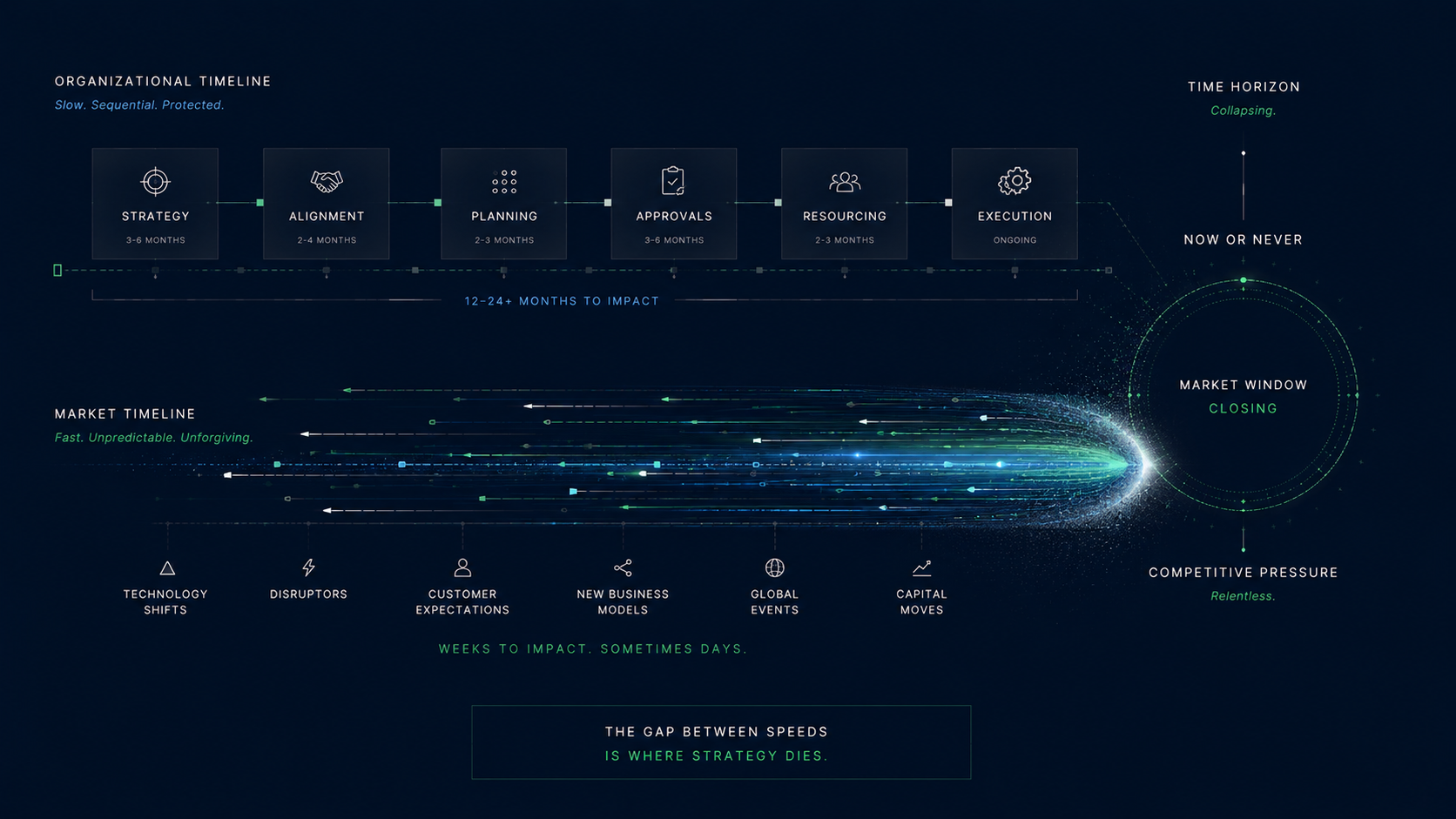
One of the most dangerous assumptions inside large organizations is the belief that there is always more time.
More time to modernize.
More time to align.
More time to improve workflows.
More time to fix systems.
More time to adapt culturally.
More time to make decisions.
Markets rarely offer that luxury indefinitely.
According to studies from Innosight, the average lifespan of companies on the S&P 500 continues shrinking dramatically compared to previous decades.
Competitive pressure accelerates continuously.
Technology accelerates continuously.
Customer expectations accelerate continuously.
But organizations often adapt much slower than the environments surrounding them.
This creates strategic vulnerability.
One of the reasons transformation becomes so emotionally difficult inside companies is because many organizations are simultaneously trying to preserve stability while adapting to instability.
And those objectives naturally collide.
Teams want clarity.
Markets create uncertainty.
Leadership wants innovation.
Operations need predictability.
Transformation requires change.
Revenue depends on execution.
The tension is unavoidable.
But pretending organizations can transform slowly forever while competitors move aggressively creates its own risk.
This becomes especially visible in industries where legacy systems, operational complexity, and international coordination already slow execution naturally.
The challenge is not simply "moving faster."
The challenge is reducing the gap between external market speed and internal organizational speed.
That requires:
- clearer priorities
- faster alignment
- less operational friction
- better communication
- and leadership capable of making difficult trade-offs earlier
Unfortunately, many transformation initiatives unintentionally increase complexity instead of reducing it.
More governance.
More process.
More approval layers.
More coordination overhead.
Meanwhile competitors continue shipping.
This is one reason why transformation leadership increasingly requires operational realism.
Not optimism alone.
Not methodology alone.
But a clear understanding that organizations are transforming inside active competitive environments.
The market does not pause while companies reorganize themselves.
And eventually, every organization reaches the same uncomfortable question: are we transforming fast enough to remain relevant?