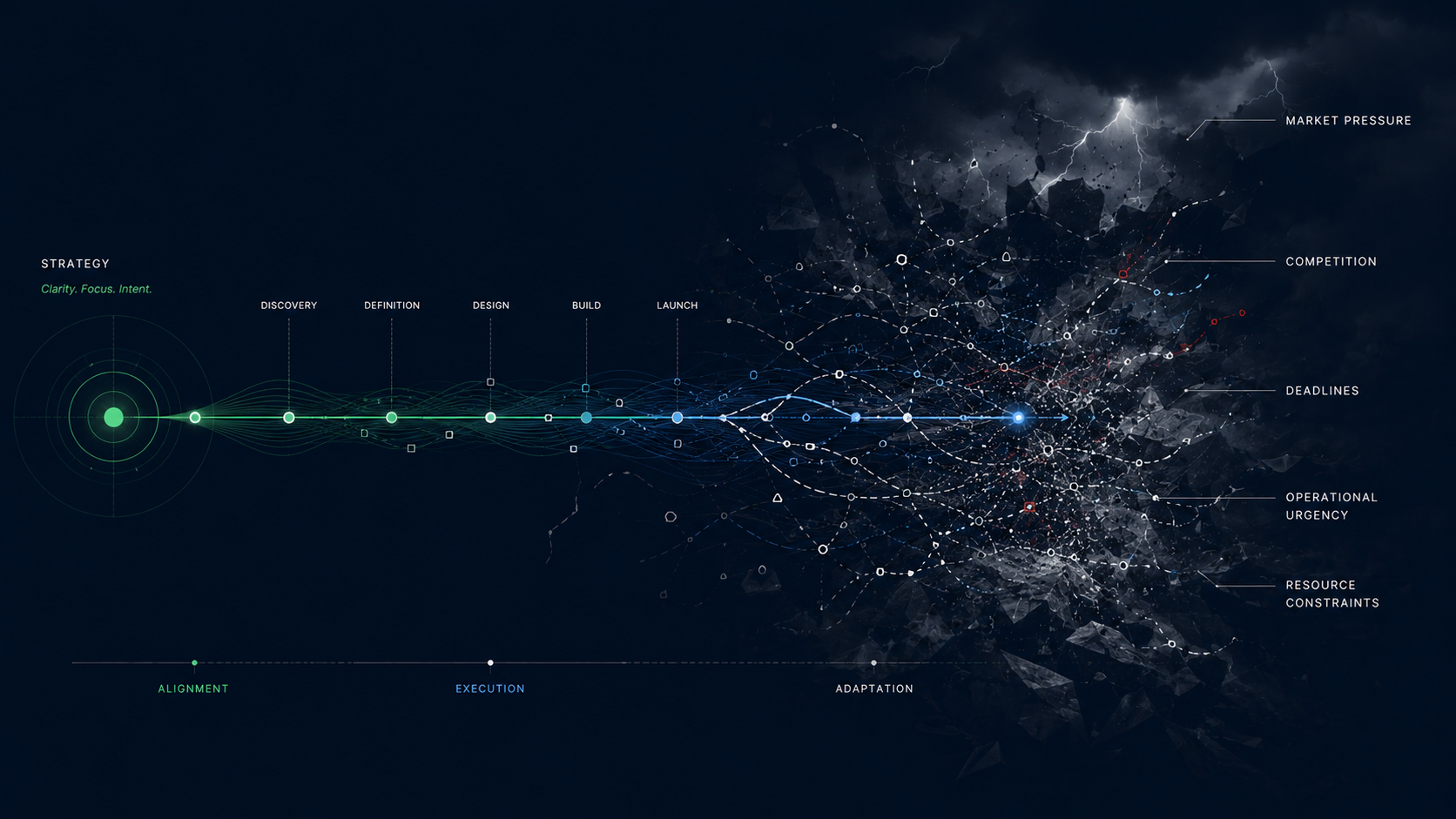
One of the easiest ways to identify whether someone has mostly observed product organizations from the outside is by how cleanly they describe product development.
Real organizations are rarely clean.
Especially when market pressure increases.
In theory, product development sounds methodical:
- research
- discovery
- validation
- prioritization
- alignment
- delivery
- iteration
In practice, many companies operate under a much harsher reality:
ship,
adapt,
survive,
repeat.
That does not necessarily mean organizations are irrational.
It means business pressure changes decision-making.
When companies are:
- losing market share
- facing competitive threats
- missing growth targets
- dealing with legacy systems
- or under shareholder pressure
the tolerance for slow optimization cycles decreases dramatically.
This is especially true outside idealized technology environments.
According to McKinsey, only a minority of companies successfully achieve both high innovation speed and organizational alignment simultaneously. Most struggle balancing operational execution with strategic transformation.
And honestly, that struggle makes sense.
Because businesses do not operate in educational simulations.
They operate inside:
- budget constraints
- competitive pressure
- legacy decisions
- organizational politics
- and real financial consequences
One of the most underestimated realities of product development is that urgency often reshapes organizational behavior faster than methodology does.
A company under existential pressure behaves differently from a stable market leader.
Priorities compress.
Decision-making centralizes.
Risk tolerance changes.
Experimentation narrows.
Leadership becomes more interventionist.
And yet many transformation frameworks still assume organizations can maintain ideal operating conditions regardless of business context.
That assumption breaks quickly.
One pattern I have observed repeatedly is that companies often try to adopt modern product structures while simultaneously operating under highly traditional business pressure.
The result creates contradiction:
- teams are told to experiment, but punished for delays
- told to innovate, but measured exclusively on short-term output
- told to think strategically, while operating inside quarterly panic cycles
This tension becomes even more difficult in multinational organizations where different markets may experience completely different business realities simultaneously.
One country may prioritize growth.
Another may prioritize stabilization.
Another may already be in defensive mode.
Trying to force identical product processes across all of them often creates friction instead of alignment.
This is why product leadership in real organizations increasingly becomes an exercise in contextual judgment.
The strongest product leaders I have seen are not the ones most attached to process purity.
They are the ones capable of balancing:
- business pressure
- organizational reality
- customer value
- and long-term direction simultaneously
Because in many companies, the reality is brutally simple: if the business fails, the transformation fails with it.