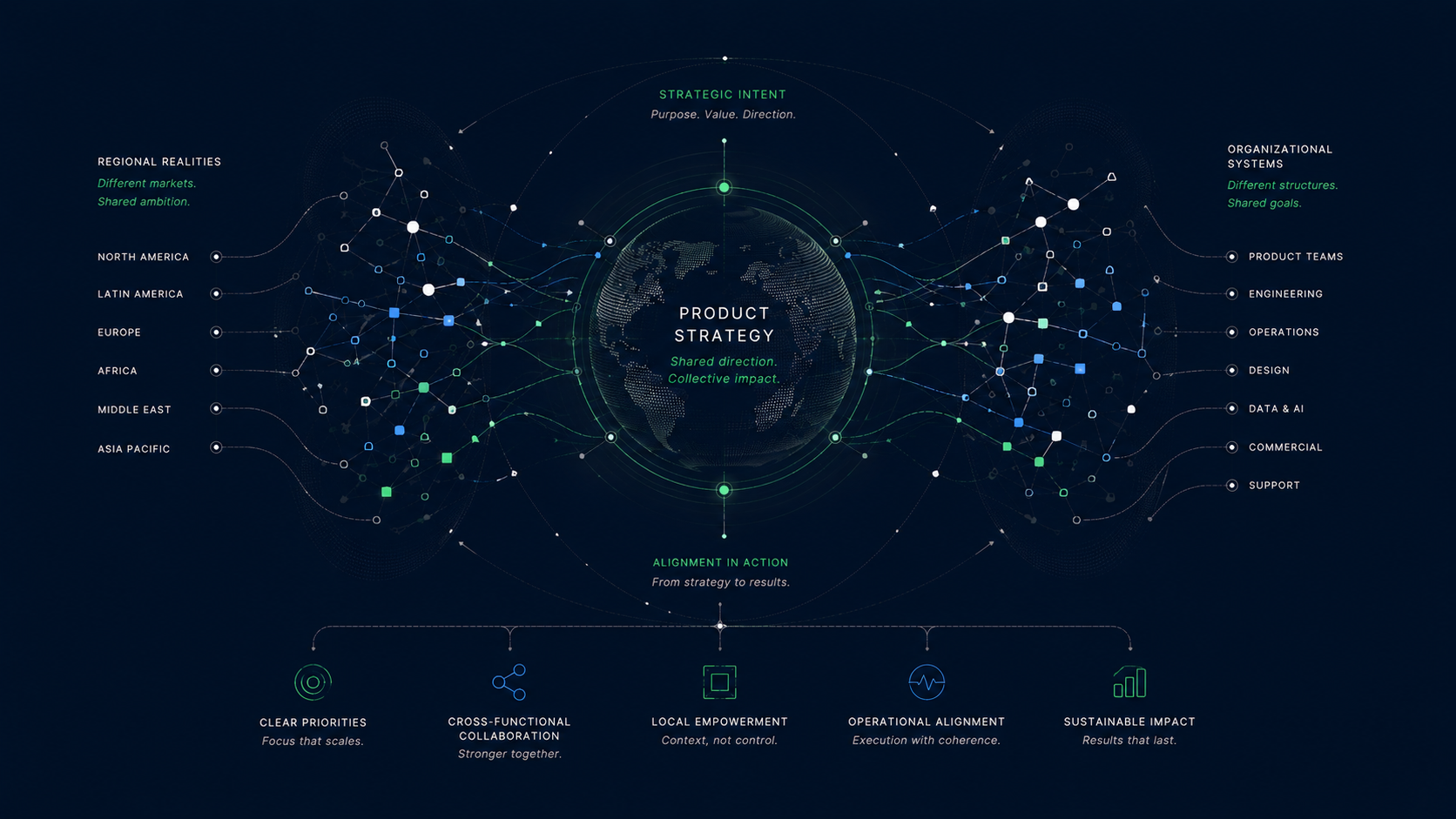
One of the biggest misconceptions about product strategy is that it is primarily about frameworks, roadmaps, or delivery methodologies.
In reality, the most difficult part of product leadership is usually not deciding what to build. It is creating enough organizational clarity and alignment so execution can happen consistently across teams, stakeholders, and markets.
As organizations grow, complexity compounds naturally:
- more stakeholders
- more dependencies
- more communication layers
- more local realities
- more technical debt
- and more competing priorities
At some point, teams stop struggling with execution itself and begin struggling with direction.
This becomes even more visible in international organizations.
One of the things I underestimated early in my international experience was how differently teams can interpret the exact same strategic message depending on culture, language, organizational context, and leadership style.
A decision that feels perfectly clear to one market may feel ambiguous or disconnected to another.
Even communication styles create friction.
A German stakeholder may interpret directness as efficiency, while another market may experience the exact same communication style as tension or resistance. Neither side is necessarily wrong — but alignment becomes difficult when leadership ignores those differences.
Over time, I realized that product leadership in international environments becomes less about controlling execution and more about orchestrating understanding.
That requires much more than process management.
It requires:
- communication
- empathy
- cultural awareness
- prioritization
- organizational clarity
- and the ability to simplify complexity without oversimplifying reality
This is one of the reasons why I increasingly see product leadership as an exercise in orchestration rather than control.
The role of leadership is not to centralize every decision. It is to create enough strategic clarity so teams can make better decisions independently while still moving in the same direction.
The strongest organizations I have seen are not necessarily the ones with the most sophisticated frameworks. They are the ones where people understand:
- why something matters
- what trade-offs are acceptable
- where the organization is heading
- and how their work contributes to broader outcomes
In practice, some of the most valuable work product leaders do is often invisible:
- aligning stakeholders
- reducing ambiguity
- creating trust across teams
- clarifying priorities
- protecting focus
- and helping organizations navigate complexity without fragmentation
Technology matters.
Processes matter.
Frameworks matter.
But in complex international organizations, alignment is usually the real multiplier.
And alignment is rarely accidental.