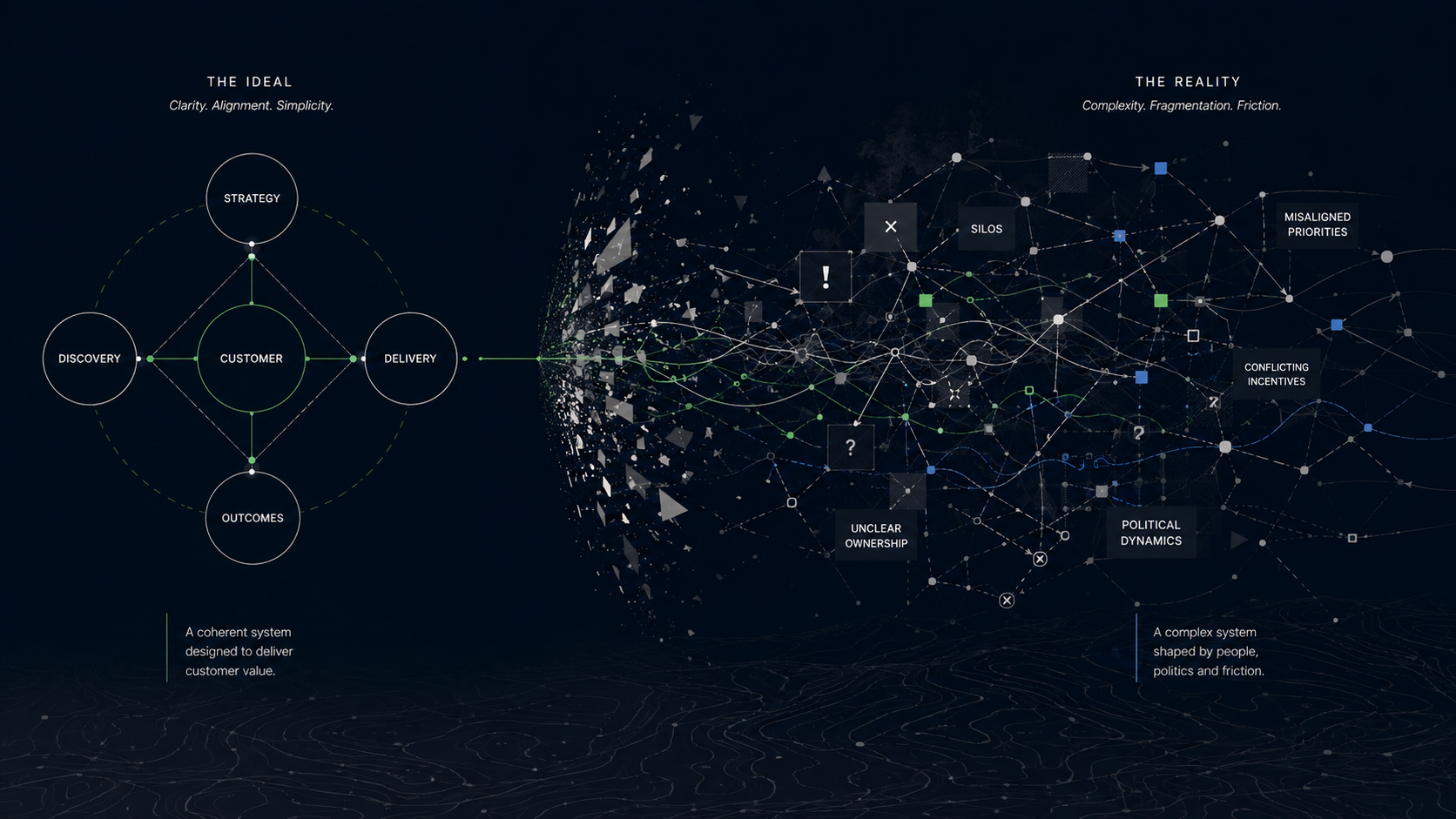
One of the reasons product advice often feels disconnected from reality is because much of it assumes organizations are already functional.
- Aligned leadership
- Clear strategy
- Healthy incentives
- Strong communication
- Empowered teams
- Stable priorities
- Collaborative culture
In other words, ideal conditions.
The problem is that many organizations — especially large international ones — operate nothing like that.
And this becomes obvious the moment you move beyond product theory and into operational reality.
According to McKinsey, roughly 70% of transformation initiatives fail to achieve their objectives. Not because the PowerPoint was weak. Not because the frameworks were missing. But because organizations struggle with alignment, incentives, communication, leadership consistency, and execution.
That distinction matters.
A lot of modern product literature focuses on:
- discovery
- experimentation
- customer obsession
- agile rituals
- empowered teams
- and continuous iteration
Those are valuable ideas.
But many organizations are simultaneously dealing with:
- legacy systems
- fragmented ownership
- political silos
- executive misalignment
- restructuring
- acquisitions
- resource constraints
- international complexity
- and pressure from the market to deliver results quickly
Transformation does not happen in a vacuum.
In reality, most companies are trying to transform while also trying to survive, compete, grow, reduce costs, modernize technology, and protect quarterly performance at the same time.
That changes everything.
One of the biggest gaps in modern product discourse is the assumption that organizational friction is secondary.
It is not secondary.
It is often the main challenge.
A company can implement every modern framework imaginable and still struggle because:
- leadership changes direction every quarter
- markets operate with conflicting incentives
- engineering and business teams do not trust each other
- or nobody agrees on what success actually means
This becomes even more complex in international organizations.
The same strategic initiative can be interpreted differently depending on:
- language
- culture
- hierarchy
- communication style
- local market pressure
- or organizational maturity
A direct communication style perceived as efficient in Germany may feel confrontational somewhere else. A highly collaborative leadership style appreciated in one market may be interpreted as weak or indecisive in another.
These things sound "soft" until they start delaying execution.
Over time, I have become increasingly convinced that product leadership at scale is less about frameworks and more about organizational orchestration.
The companies that execute well are usually not the ones with the most sophisticated product vocabulary.
They are the ones capable of:
- creating alignment
- reducing ambiguity
- maintaining strategic consistency
- and helping teams move together despite complexity
Frameworks help.
Processes help.
Product thinking matters.
But organizational reality always wins. And many companies are far less rational, aligned, and stable than product theory likes to assume.