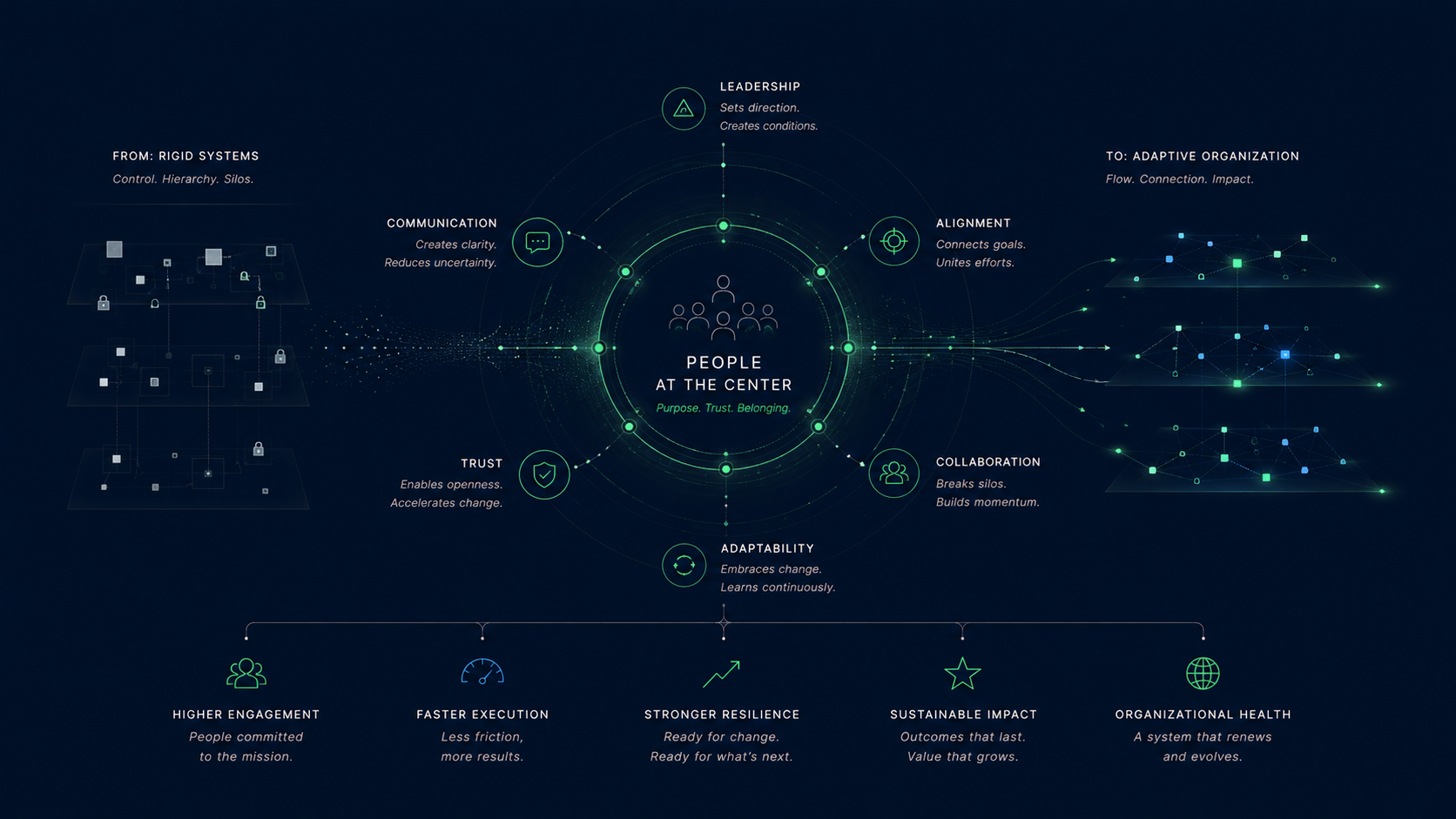
Most transformation initiatives focus heavily on systems, platforms, delivery timelines, and implementation roadmaps.
Far fewer spend enough time thinking about people.
And yet transformation is fundamentally human.
Organizations do not transform because new tools are introduced. They transform when people:
- adopt
- align
- collaborate
- change behaviors
- and move in the same direction
That is significantly harder than implementing technology.
One of the biggest mistakes organizations make is assuming resistance to change is irrational.
In reality, resistance often emerges from uncertainty:
- unclear direction
- conflicting priorities
- lack of communication
- fear of losing ownership
- or different interpretations of what success actually means
This becomes even more complex in international organizations.
The same transformation initiative can create completely different emotional responses depending on market culture, leadership expectations, communication style, or organizational maturity.
In some environments, people challenge openly. In others, disagreement remains implicit. Some teams prioritize speed. Others prioritize certainty and structure.
Leadership becomes critical in those moments.
Strong leaders help reduce unnecessary ambiguity while creating enough trust for teams to move forward together.
That requires:
- communication
- empathy
- consistency
- strategic clarity
- and emotional intelligence across cultures and teams
One of the most valuable lessons I have learned working across international environments is that transformation cannot rely exclusively on process and governance.
Organizations often underestimate how deeply communication style influences alignment.
A message perceived as transparent in one culture may feel confrontational in another. A leadership approach perceived as collaborative in one market may feel vague in another.
Understanding those differences becomes essential when trying to align teams around change.
This is one of the reasons why I increasingly see leadership as an exercise in enabling others:
- creating clarity
- removing friction
- connecting teams
- building trust
- and helping people navigate complexity together
The strongest organizations are usually not the ones with the most aggressive delivery targets.
They are the ones capable of combining:
- strategic direction
- operational clarity
- adaptability
- and people-centered leadership
Technology will continue evolving rapidly.
AI will continue reshaping workflows.
Organizations will continue becoming more international and interconnected.
But sustainable transformation will still depend on people: their trust, their alignment, their communication, and their ability to move together toward a shared direction.