Early in their careers, many product managers believe their primary job is:
- prioritization
- roadmaps
- customer discovery
- or stakeholder management
Those things matter.
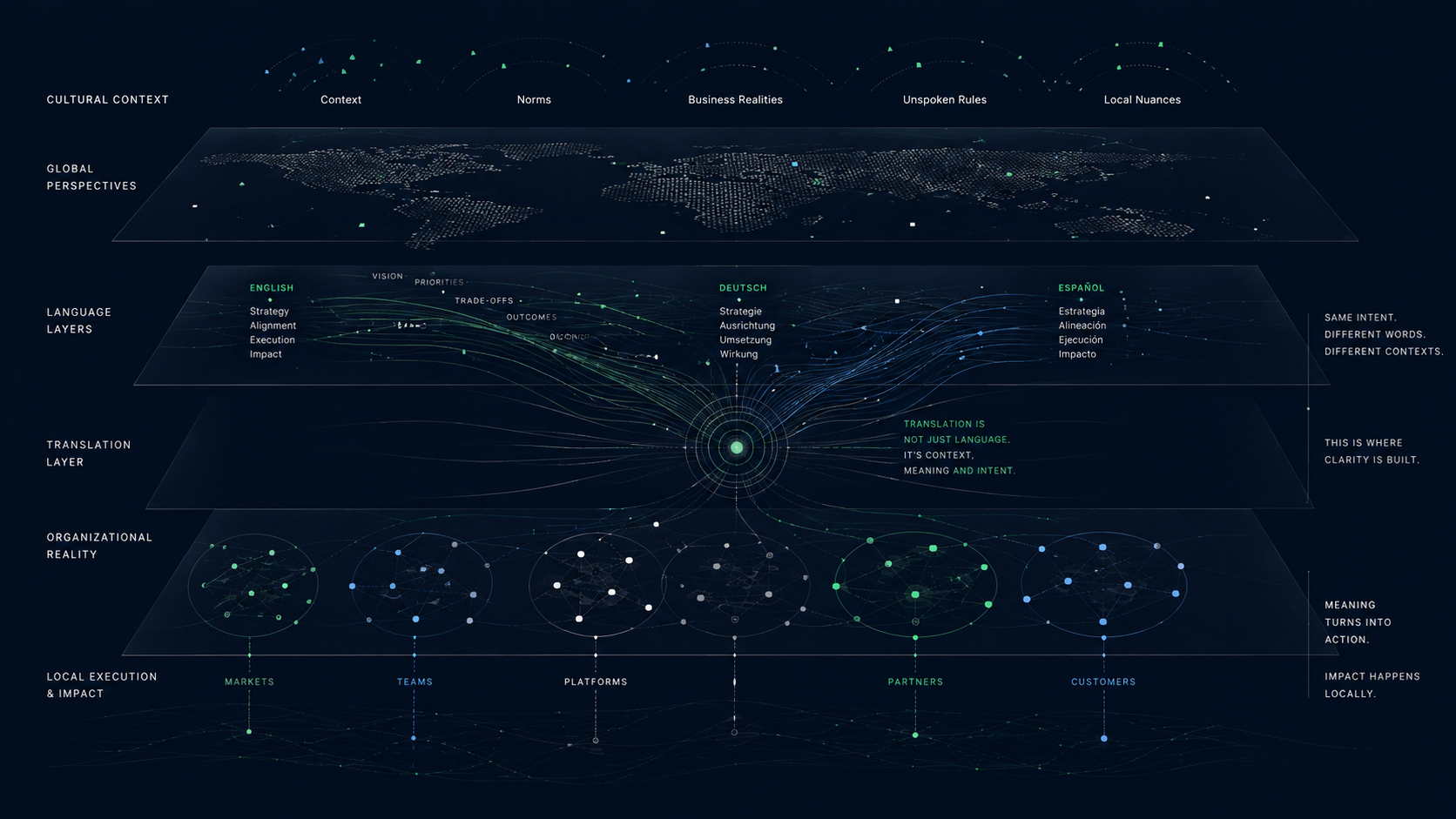
But in complex organizations, the role evolves into something much more difficult: organizational translation.
At scale, product managers spend enormous amounts of time translating between:
- executives and engineering
- strategy and execution
- global and local priorities
- business and technical language
- leadership intent and operational reality
And in international organizations, cultural translation becomes equally important.
One of the things I have learned working across Europe, LATAM, and the Middle East is that people often assume alignment exists because the same words are being used.
In reality, teams can leave the same meeting with completely different interpretations of:
- urgency
- ownership
- success
- timelines
- or accountability
Language plays a huge role in this.
When organizations operate in English internationally, many people assume communication becomes standardized. It does not. People still think through the lens of their own culture, communication style, and organizational experience. The same sentence can carry completely different emotional meaning depending on the audience.
This is one of the reasons why product leadership in international organizations becomes deeply human work.
And honestly, this is also where many frameworks begin to break down.
Most product literature focuses heavily on:
- process
- discovery
- prioritization
- and delivery
Far less attention is given to:
- trust-building
- political navigation
- communication asymmetry
- organizational psychology
- or multicultural alignment
Yet those factors often determine whether execution succeeds.
According to Harvard Business Review, communication failures remain one of the primary contributors to organizational underperformance globally. In international environments, the complexity compounds significantly.
Over time, I have become increasingly convinced that some of the strongest product leaders are not necessarily the most technically sophisticated.
They are the ones capable of reducing friction between humans.
Because modern organizations are full of invisible translation layers:
- between markets
- between departments
- between leadership levels
- between incentives
- and between cultures
And those translation gaps become operational bottlenecks surprisingly quickly.
Personally, growing up with both German and Latin American cultural influences has shaped the way I approach leadership significantly. Working in English, living in Germany, speaking Spanish at home, and navigating different communication styles across markets has often helped me identify alignment problems earlier than process alone would reveal them.
That perspective has repeatedly become an operational advantage.
Because in many organizations, the real challenge is not lack of intelligence.
It is lack of shared understanding. And product leadership increasingly lives at the intersection of both.