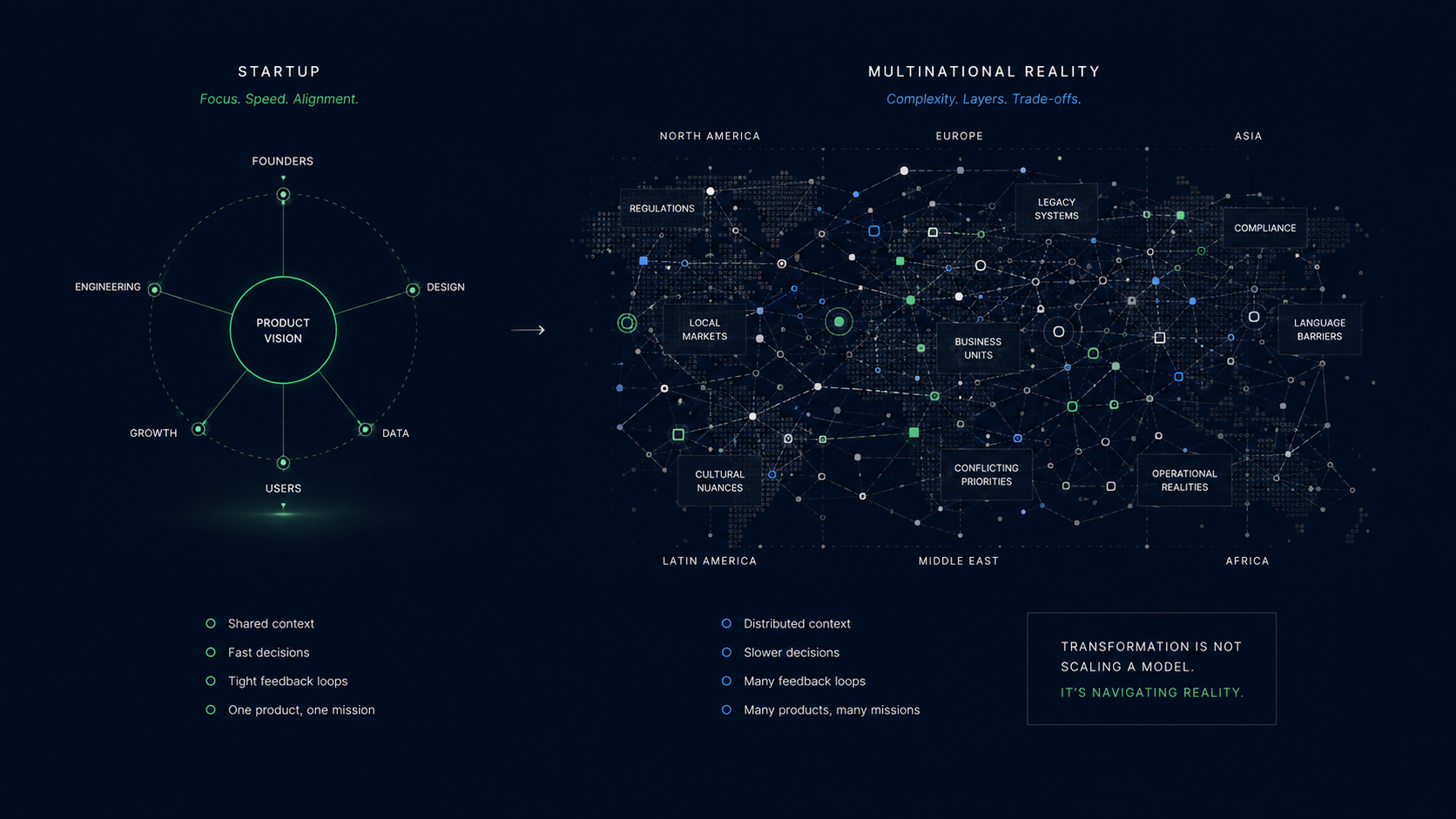
Silicon Valley has produced extraordinary companies, technologies, and management ideas.
But one of the unintended consequences is that many organizations now attempt to copy environments that are fundamentally impossible to replicate.
A founder-led startup in California operates under very different conditions than:
- a multinational European organization
- a regulated industry
- a post-acquisition company
- or a distributed enterprise operating across dozens of markets
Yet many transformation initiatives still assume the same operating models should apply universally.
This creates tension quickly.
Startups often benefit from:
- concentrated leadership
- high alignment
- rapid decision cycles
- unified culture
- small teams
- and limited organizational layers
International organizations rarely have those conditions.
Instead, they operate across:
- languages
- markets
- legal systems
- stakeholder groups
- organizational histories
- and different cultural expectations around leadership itself
This complexity changes how transformation works.
A process that scales efficiently inside a startup may create enormous friction inside a multinational enterprise. A communication style perceived as transparent in one culture may feel confrontational in another. A highly decentralized structure may empower one market while creating instability somewhere else.
These differences matter operationally. And they are often underestimated by leaders trying to import "best practices" without adapting them to context.
One of the realities I have experienced repeatedly across Europe is that organizational alignment moves at different speeds depending on cultural expectations.
Some environments value directness and speed.
Others value consensus and relationship-building.
Some prioritize autonomy.
Others prioritize coordination and structure.
Neither approach is inherently superior.
But pretending these differences do not exist creates unnecessary friction.
This is one reason why I believe international leadership requires a different mindset from startup leadership.
It requires:
- patience
- translation
- adaptability
- contextual awareness
- and the ability to create alignment across very different operational realities
Transformation in international organizations is rarely linear.
It is negotiation.
Coordination.
Alignment.
Communication.
And continuous adaptation.
That complexity can feel frustrating.
But it is also what makes international organizations incredibly interesting environments to lead inside.