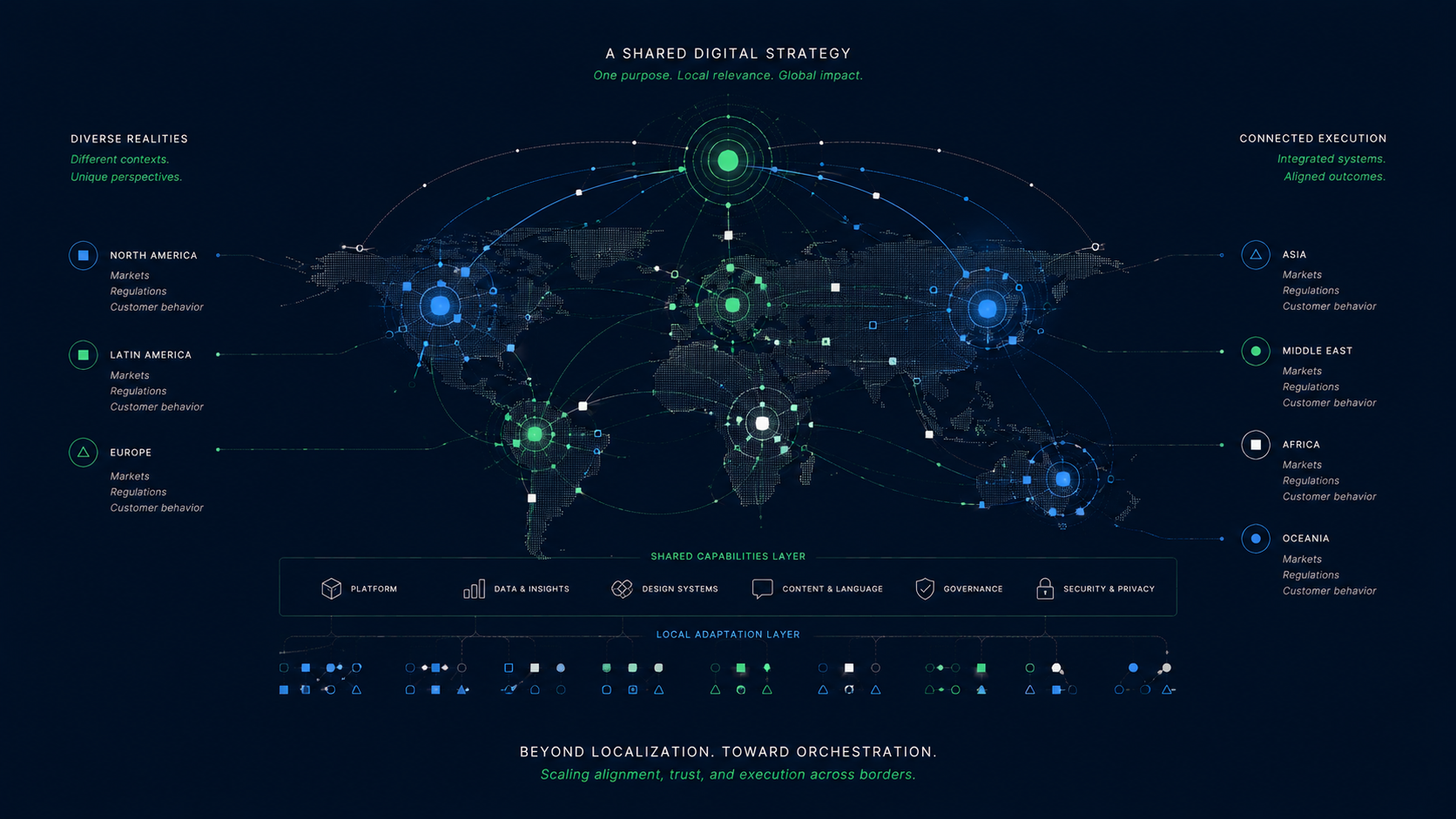
Many international digital initiatives fail because organizations underestimate complexity.
On paper, scaling across markets often appears straightforward:
- translate the content
- replicate the platform
- launch in multiple countries
- and standardize execution
In practice, international growth is rarely that linear.
Every market operates within its own context:
- different customer expectations
- different communication styles
- different organizational maturity
- different commercial priorities
- different stakeholder dynamics
- and different cultural realities
What works perfectly in one country may create friction in another.
One of the things I have learned working across international markets is that many operational challenges are not actually technical.
They are cultural.
They emerge through:
- misaligned expectations
- different interpretations of urgency
- different communication norms
- different levels of hierarchy
- or different assumptions about ownership and accountability
Sometimes even humor, feedback styles, or meeting dynamics can influence execution quality more than process documentation.
This is especially visible in organizations attempting to balance centralization with local flexibility.
Central teams naturally seek:
- consistency
- governance
- scalability
- efficiency
- and operational clarity
Local markets often prioritize:
- speed
- customer proximity
- relevance
- flexibility
- and commercial responsiveness
Both perspectives are valid.
The challenge is building systems capable of supporting both simultaneously.
This is why successful international digital growth depends less on pure execution and more on orchestration.
The organizations that scale effectively internationally are usually the ones that create:
- clear governance
- aligned priorities
- strong communication structures
- shared operating principles
- and enough flexibility for local adaptation
Technology alone does not solve this problem.
The complexity is organizational and human as much as technical.
Leading initiatives across multiple countries requires more than project management. It requires understanding how people think, communicate, build trust, challenge ideas, and interpret leadership differently depending on culture and experience.
For me personally, having grown up with both Latin American and German cultural influences has often become an operational advantage in international environments. Working in English, living in Germany, speaking Spanish at home, and navigating both German and Latin communication styles has helped me better understand how differently teams can approach the same problem while still pursuing the same objective.
That perspective has repeatedly helped me bridge gaps between markets, teams, and organizational expectations.
International growth is ultimately not about launching in more countries.
It is about building organizations capable of scaling alignment across them.