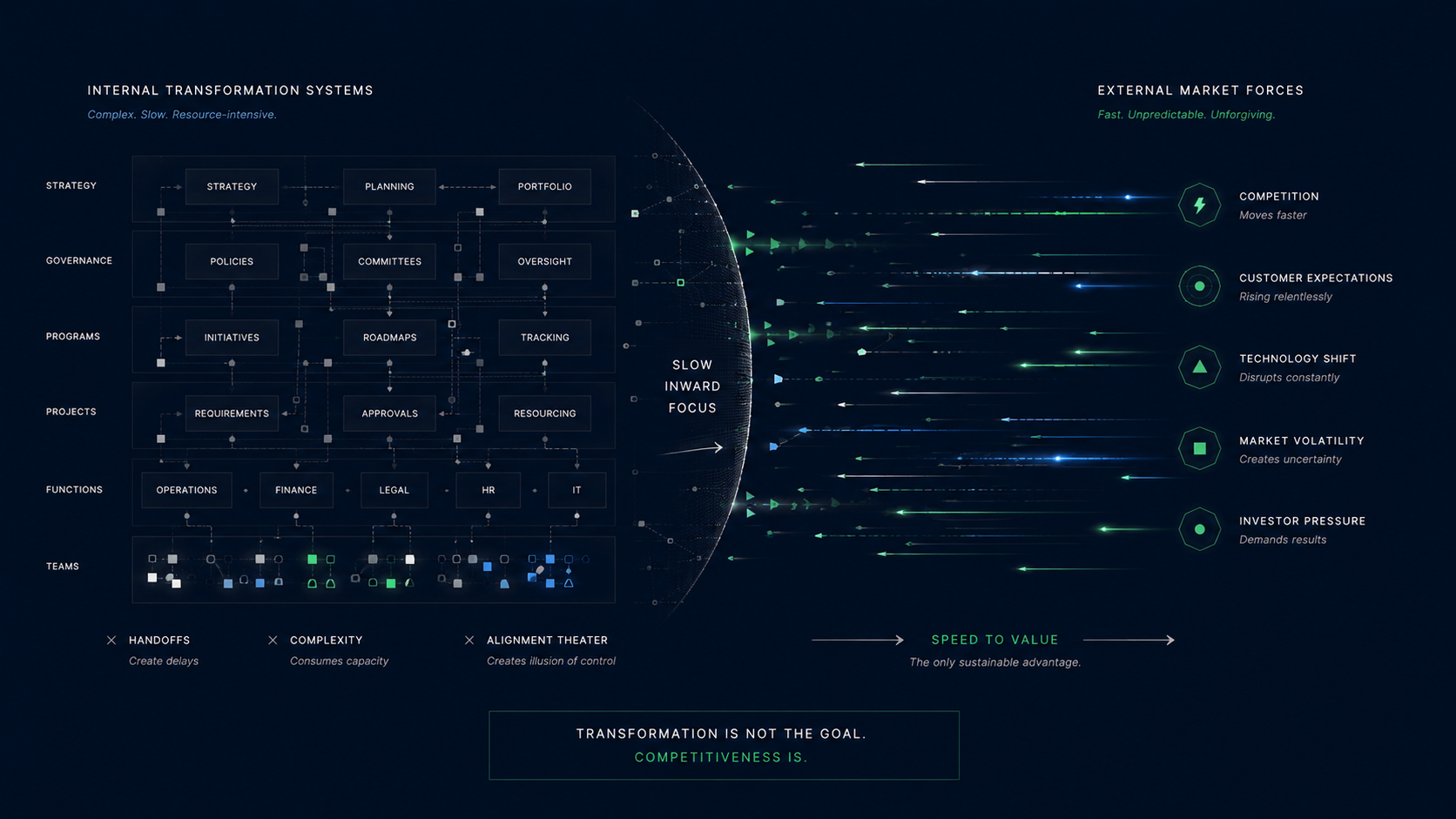
One of the dangers of modern transformation culture is that transformation itself sometimes becomes the objective.
Organizations begin measuring success by:
- framework adoption
- operating model redesign
- AI implementation
- agile maturity
- or digitalization metrics
Meanwhile the market keeps moving.
Customers rarely care whether a company completed an internal transformation roadmap.
They care whether the company:
- delivers value
- moves quickly
- solves problems
- communicates clearly
- and remains competitive
That distinction matters enormously.
Because transformation is not inherently valuable.
Competitiveness is.
Transformation only matters if it improves a company's ability to:
- adapt
- execute
- scale
- innovate
- or survive
Otherwise it risks becoming organizational theater.
This becomes especially dangerous in industries facing intense disruption pressure.
According to Accenture, companies across multiple sectors are now operating inside significantly shorter competitive cycles than even a decade ago.
Technology changes faster.
Customer expectations evolve faster.
Market disruption spreads faster.
Organizations are under pressure constantly.
And yet many transformation initiatives still operate with timelines, governance structures, and decision cycles that move far slower than the market itself.
This creates a painful contradiction.
Teams are told transformation is urgent while operating inside systems incapable of moving urgently.
Eventually frustration accumulates.
One of the realities I have seen repeatedly is that many organizations unintentionally separate "the business" from "the transformation."
Operational teams focus on revenue and execution.
Transformation teams focus on frameworks and change management.
But the market does not experience them separately.
The customer only sees the result.
This is why the strongest transformation environments are usually the ones where modernization directly supports competitive execution:
- faster delivery
- better customer experience
- better decision-making
- better scalability
- better collaboration
Transformation works best when teams experience it as operational acceleration rather than organizational overhead.
And that requires leadership capable of connecting long-term evolution with short-term business reality.
Because companies are not transforming for philosophical reasons.
They are transforming because:
- competition intensifies
- technology evolves
- customer expectations rise
- and operational inefficiency becomes economically dangerous
Transformation is not the destination. Remaining competitive is.