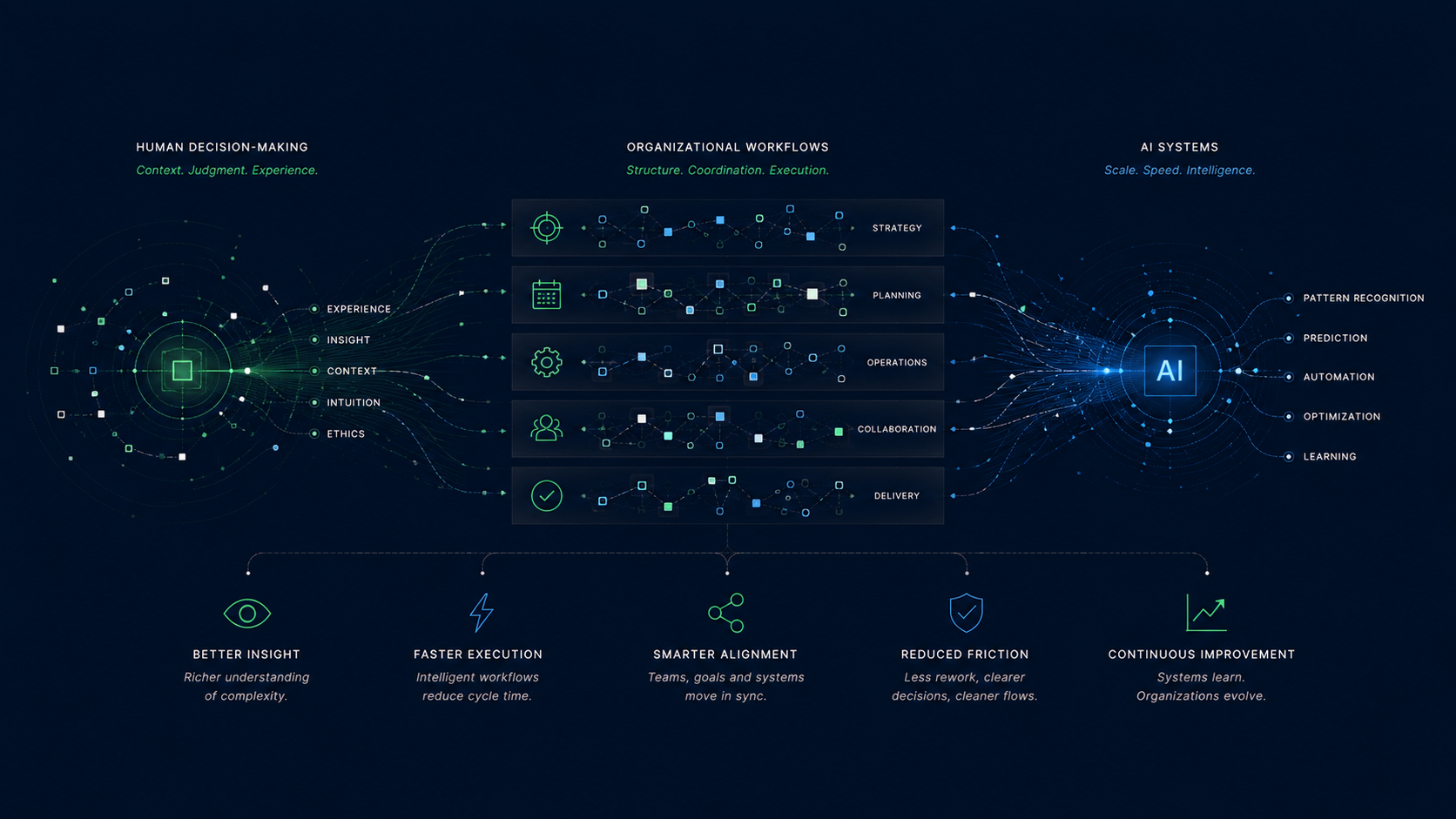
Much of the public conversation around AI still focuses on replacement:
- Which jobs disappear?
- Which roles remain safe?
- What can automation do faster than humans?
Those are important questions, but they are incomplete.
What I find more interesting is how AI changes workflows themselves.
Most organizations today are still structured around operational models designed for a different technological era:
- manual coordination
- information silos
- slow decision cycles
- fragmented tooling
- and repetitive knowledge work
AI introduces a different possibility.
Not simply faster execution, but a fundamentally different relationship between people, information, communication, and decision-making.
In many organizations, the real opportunity is not replacing people. It is reducing friction.
Friction in:
- communication
- documentation
- reporting
- coordination
- discovery
- analysis
- and execution
That becomes even more relevant in international environments.
One of the realities of working across markets is that complexity often compounds through language and cultural interpretation.
The same meeting can produce completely different conclusions depending on how teams process information, challenge assumptions, or interpret priorities.
AI has the potential to reduce part of that friction by improving access to knowledge, accelerating synthesis, and making information more accessible across organizational boundaries.
But AI alone does not solve alignment problems.
In fact, organizations that lack strategic clarity can become even more chaotic when speed increases faster than coordination.
This is why I increasingly believe AI adoption is primarily a leadership challenge rather than a tooling challenge.
Organizations often ask:
- Which platform should we buy?
- Which model should we use?
- Which vendor is best?
But the more important questions are:
- How should workflows evolve?
- How should teams collaborate differently?
- How do we preserve clarity as speed increases?
- How do we integrate AI into decision-making responsibly?
- How do we avoid amplifying organizational noise?
The companies that benefit most from AI will likely not be the ones with the largest number of tools. They will be the ones capable of integrating AI into coherent operational systems.
That requires strategic thinking. It also requires human leadership.
Because while AI can accelerate workflows dramatically, organizations still depend on people to:
- define direction
- navigate ambiguity
- build trust
- align teams
- and make strategic trade-offs
Technology evolves quickly.
Organizational adaptation usually moves much slower.
The leaders who can connect both worlds — technology and human complexity — will shape the next generation of digital organizations.